Learning How to Learn
A week of fasting, learning about learning and a new philosophy
Hello from my home in Helsinki! This is NordLetter #115, a weekly newsletter on living and walking in Finland. Each week I share some of the interesting things I found on the web.
To follow the series, you can subscribe here. A new NordLetter will land in your inbox every Sunday. Not a fan of newsletters? No problem! You can read previous editions here. You can also subscribe to the RSS feed.
You can reach out to me by replying to this mail. I am also posting on Mastodon.
A couple of updates related to last week.
The extended fasting routine is going well. For most of last week, I have not had a breakfast. This has been my routine:
- Get up, freshen up.
- Workout/yoga.
- Take a shower.
- Go to the office.
- Have a coffee/really use my phone.
- Around 11-12, go for lunch.
When I go to lunch is a factor of when my last meal was. If I had dinner at 17:00, I feel hungry earlier.
Another thing is thanks to the affirmation diary, I have just that little bit of friction, which allows me to not pick up my phone in the morning. I managed to watch the Craig Mod interview, it just added to my resolve of not wanting to pick up my phone first thing in the morning.
Two things have dominated my thinking this past week.
- I’ve been thinking about memory and how to improve it.
- And also about [[202607221608 Separation of Tasks|separation of tasks]].
After Prerna had returned from her last Python Meetup where she was an organiser (yay!), she told me she had signed me up for a talk in the next meetup. My first response, per usual, was why? What would I speak about? I am not a coder! And so on.
I had mostly forgotten about it till this week. But then on Monday, I started thinking about it.
What could I talk about?
The whole, I built a website using LLMs seems to be beaten to a pulp by now.
Eventually, I came up with this - how to use AI to learn better.
This was of course my topic at CITCON’26. I care about learning and I have used Claude to build the website of my dreams.
I had not found anything concrete after my session at CITCON. What I was looking for was things people had done to learn better with AI. What I got was the advice that you basically have to do the work in order to learn anything.
I am working on how to present this and what all I will talk about. But this led me down a rabbit hole to figuring out what the optimal ways to learn and to an old note I had taken while reading Range - How to learn effectively.
I went and read Andy, found and read some of his notes again. Andy has been one of the major inspirations for the things I do, these notes I take from time to time.
I read about spaced repetition and how it is awesome if you want to remember something. Remembering something is of course a problem I have. I can’t seem to remember people’s names. And I think, the problem is that I don’t try.
I want to also remember new words from both English and Finnish. I also want to remember Linux commands. And so, I had Claude build all these features in my site.
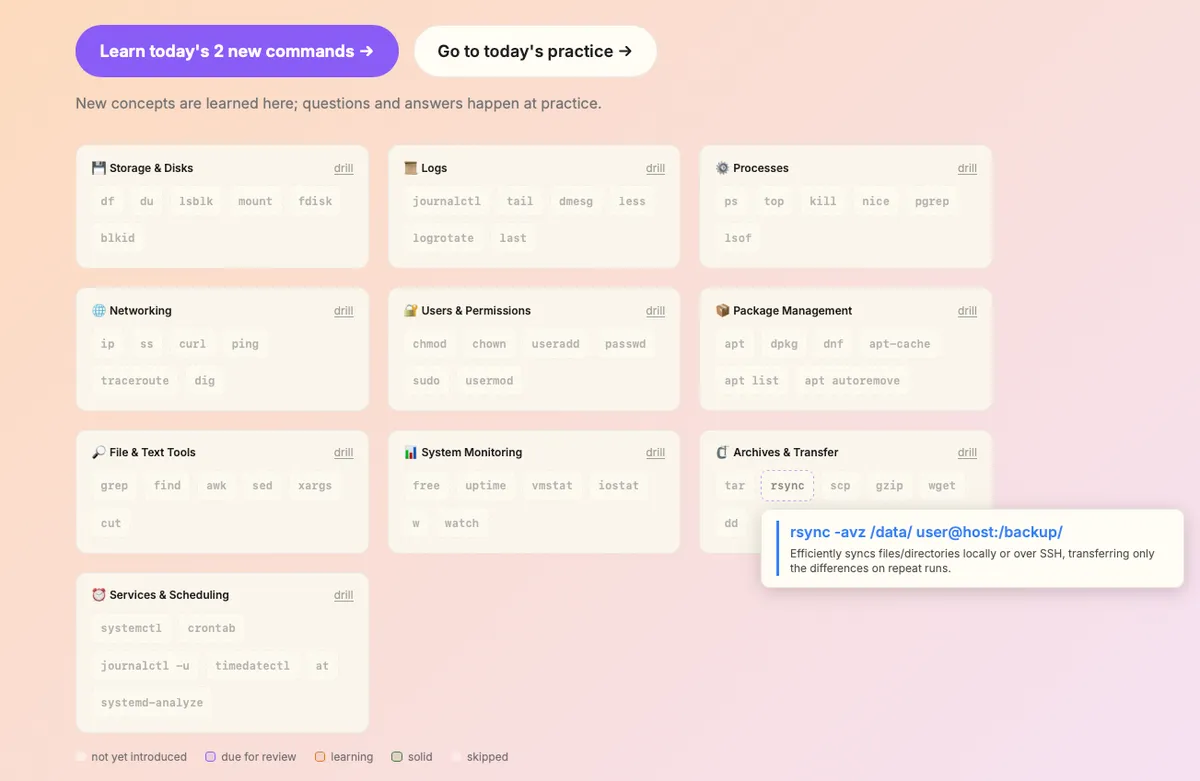
There’s a learn hub, with links to different sections - Linux, Finnish, etc. The Linux learning section has a page which lists out all the commands - inspired by the periodic table I used to have stuck on my wall while I was preparing for JEE.
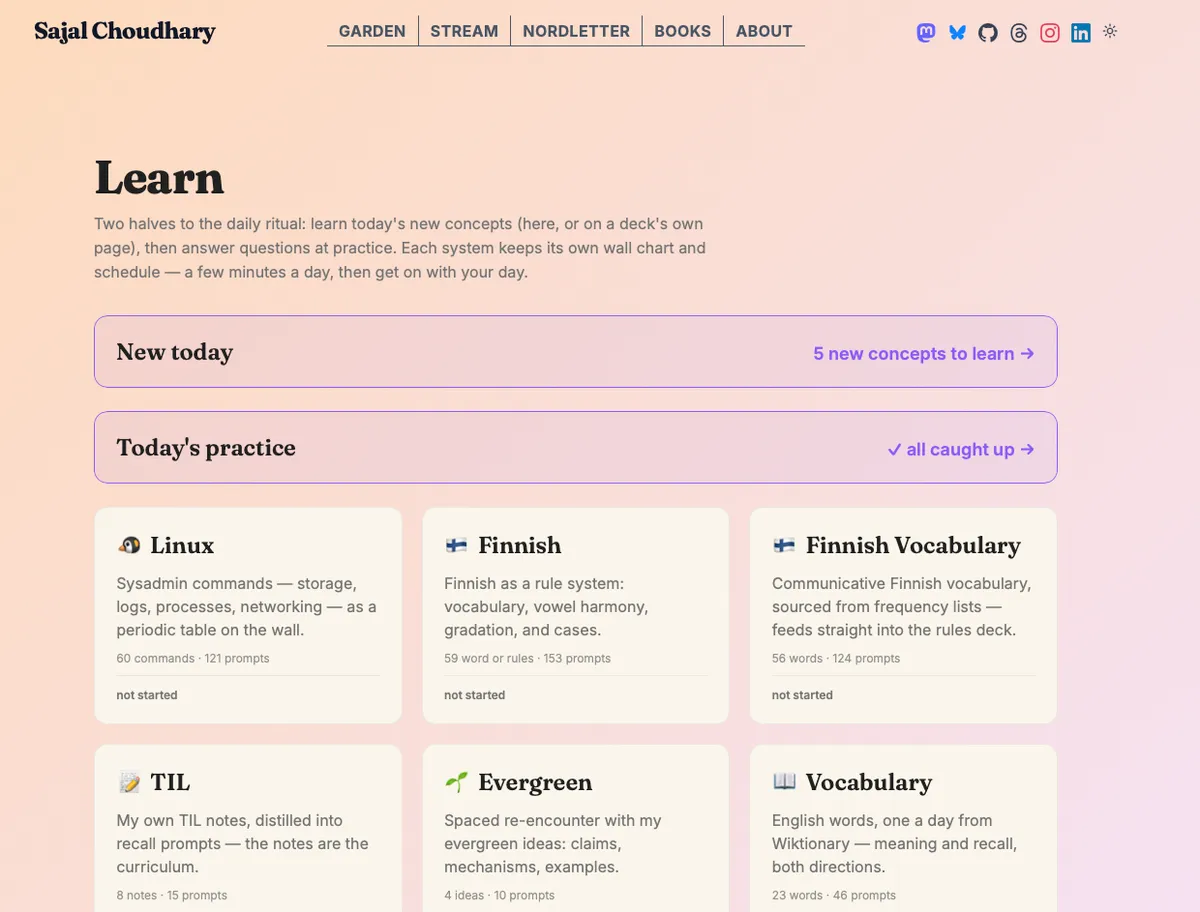
And finally, combining all these things is a Practice hub, which allows an intake of 5 new cards every day and follows an algorithm to remind me based on spaced repetition principles.
If you want to read more about spaced repetition, here’s my note on it.
Some interesting further reads on this-
- The seminal essay by Michael Nielsen - Augmenting Long-term Memory
- NCase - it’s cartoons!
- Derek Sivers post on using SRS to memorise programming.
The NCase one I highly recommend you check out.
I finished reading The Courage to be Disliked this week.
Someone at the TCS Bibliography Group had mentioned that this had been a life-changing book for them. And I thought, if that does not make it a worthy recommendation, what else can. On the first day, when I started reading it, I realised the assertion that this was a life-changing book was correct, and it would be a life-changing book for me as well.
The Courage to be Disliked is written by two Japanese authors, based on Alfred Adler’s philosophy.
I found myself taking many notes as I read this book, but the work of thinking about these things remains. That is the whole point after all. To convert the author’s thoughts, assimilate them in my mind and with my thoughts. To write about the concepts in my words. To see if they make sense to me or not. To see how I could incorporate the philosophies in my life.
One of the core ideas for me at least was this - we need to recognise what our tasks are, and what someone else’s tasks are. We need to separate the tasks. And then we need to work on our tasks. This was explained in terms of raising an unruly child - someone who refuses to study. Most parents would worry about that, scold them, do their work. But studying is the child’s task. You can help them, sure, but you can not study for them. It’s their task.
As they say, you can take a horse to the water, but not drink the water.
There are not that many books which I consider life-changing. Before this, it was The Road Less Travelled, and recently, Outlive.
So, try and give it a read.
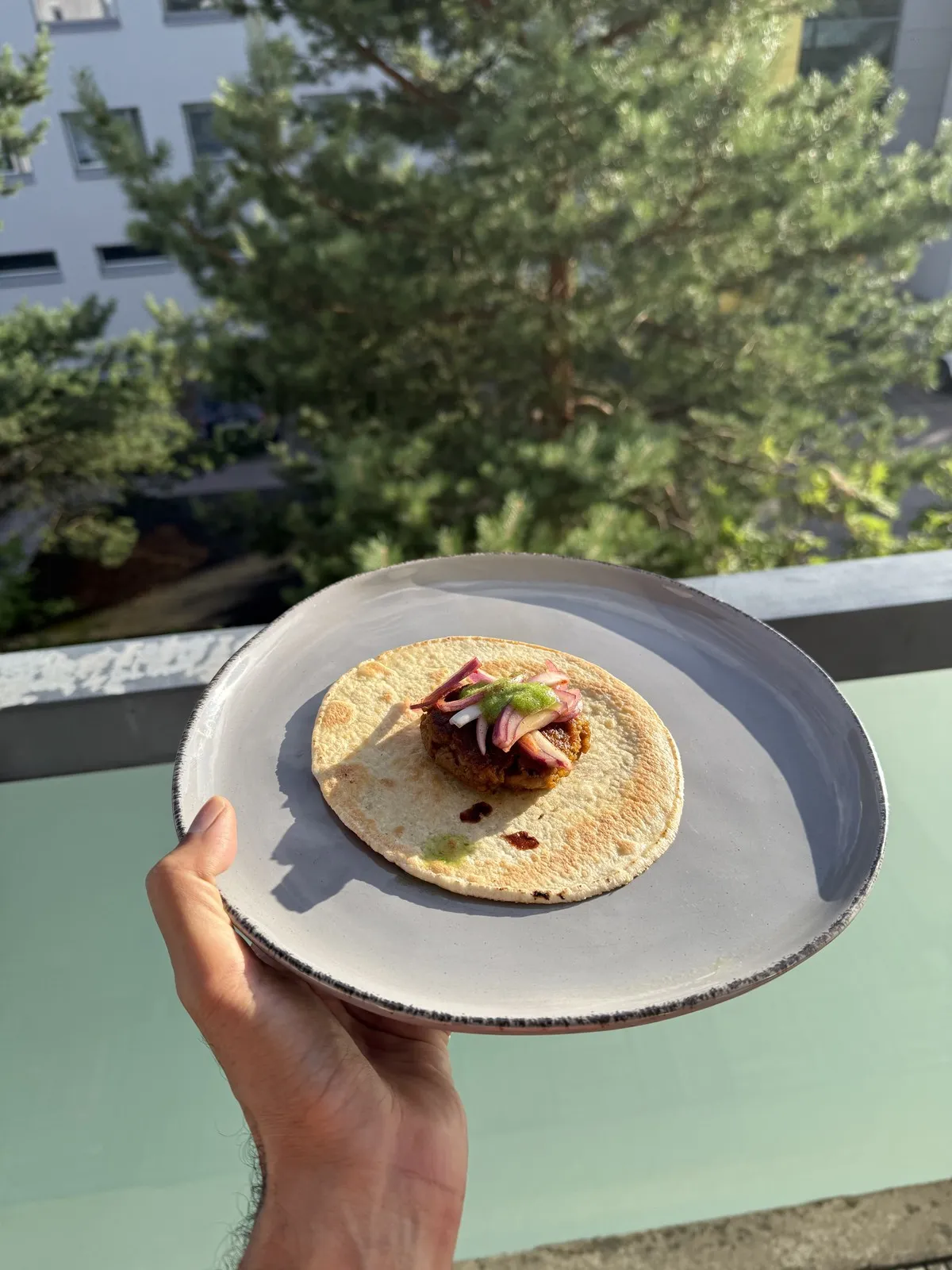
I made some mushroom galouti kebabs this week. Two ways to serve - one as is with some onions and chutney and the other with a paratha.

I had hoped Savya would enjoy these, but somehow he ate the first bite with chutney, found it to be too spicy and did not eat any after that.
Oh well, we will try again.
If you enjoyed reading this, and know someone else who might, please consider forwarding this to them. It would help this grow and make me happy. 😄
Until next week.
Subscribe to NordLetter
A weekly newsletter on living in Finland.
Interactions
1 like from around the web