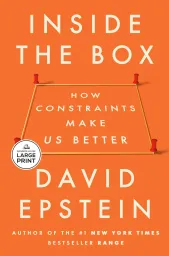
Review
My second David Epstein book, after Range. I had put it on hold at the library ever since I had come to know of this book. There was a long wait, and then I got it at the beginning of October.
This book talks about the power of constraints - how constraints help us focus our thinking - leading to Mendelev coming up with the periodic table for example, about how it may help us to live better. Most of the practical instructional sort of things came in the final chapter.
The concepts in this book, the stories, I have read them elsewhere, in different books. So you could say that there were not that many surprising stories. What kept happening, time and again is depending on context, the same story can mean different things to different people. There were many such stories, and many such thinkers and philosophers introduced throughout the book. Books and media that I have since added to my queue.
I always love it when a person mentions the books they’ve read or the books that have
shaped them as a person. This book had plenty of that, so thanks David.
I found value from this book. It strengthened some of the things I have come up on by myself, like focusing on one thing to learn at a time - no matter how tempted I am to pick another, my social media use, how I read and so on.
This is an excellent read. The book is not boring, or text-book like. Highly recommended.
Notes
The constraints-led approach may also take hold simply by accident. Kyrie Irving, one of the greatest finishers in NBA history, grew up playing on a driveway hoop that was missing a piece of the right side of the backboard. As an ESPN article re-counted: “Repairs might have been made but for a peculiar benefit: Kyrie learned how to play strange angles and apply spin just so.” In line with Catrinel Tromp’s Green Eggs and Ham model of creativity, cutting down a physical problem space leads to more active exploration.
Sachin Tendulkar talks about a similar constraint. He used to play in streets where there is no square of the wicket. That meant you play with a straight bat, which led to his classic straight drives on the field.
What information consumes is rather obvious: it consumes the attention of its recipients. Hence a wealth of information creates a poverty of attention.”
Perhaps a similar thing I noticed while I uninstalled NetNewsWire from my phone. Though I did not find any benefit to removing it from my phone - anecdotally at least.
Darwin’s case highlights the reality about breakthroughs. They are evolutionary, not revolutionary, and they always come from some-where. They come from specific ideas that are all around, in the air of a time, so to speak. Because they are in the air, multiple people can make the same breakthrough at once. As professor of neuroscience and psychology Robert Weisberg has written: “The creative process is based on inside-the-box thinking… We use old ideas in creating new ones.”
I should create a note on this. It is a fairly common idea after all.
The implication of multiple discovery is that lone geniuses and lightning strikes of inspiration matter less than the constraints that put a clear problem in focus.
This is an interesting idea.
Researchers have since found that people exposed to war undergo a long-lasting increase in local community involvement and leadership, and in lab experiments demonstrate increased cooperation toward members of their community even years later. Incredibly, this goes for both the victims and perpetrators of violence. “[Durkheim’s] findings,” Haidt wrote in his book on happiness, “can be summarized in one word: constraintsiẠại
Could be titled - People Require Constraints for Meaning.
Paths into this note
8 notes lead here
-
I am reading Inside the Box and it talks about constraints being the way to true freedom. I wrote about it in NL127.
-
I am reading Inside the Box, and like Range before this, there seem to be many new things for me to read about and learn in this book. Also, it's more approachable. Which is because it is using (not sure if by design) one of the techniques from how to learn effectively - making connections.
-
It’s a good idea to complete one chapter each day. I have read a few chapters right now from the book Inside the Box. Of course this is not meant to dissuade oneself from reading. Like one should not think that they need enough time to complete a chapter, otherwise don’t start. Rather, it’s take some time and complete the chapter you start.
-
Read this first in Inside the Box.
-
Read about it in Inside the Box, but of course I’ve known of this idea from before. Like, when I wrote somewhere that, unimaginable is usually imaginable, truly unimaginable things are impossible to imagine. I read about a similar idea in Abundance, where they talked about who gets funded for new research - it’s not truly new research, it’s familiar research. Though the story was different there.
-
Other than poetry, I finally picked up Inside the Box this week and also Just for fun, which is about Linus and Linux. All hardcovers. I really do love hardcovers. Though I prefer my book - a year of mornings in paperback.
-
A funny thing happened as Jukka started his talk. He mentioned they have freedom to try things out in terms of AI development in Elisa. That nobody is telling them what to do. And I thought, but is that good? I am reading Inside the Box right now, and one of the first stories in the book is about how constraints are good and so on.
-
While reading Inside the Box today, I came across the story of Mendelev and how he discovered the periodic table. David talks about how, in a book about sleep, the author mentioned that when he slept, his unconscious mind made sense of all the facts and gave him the solution. Then, David says that's not it. Mendelev had a book contract and he had to write about around 53 elements in a single volume, so he was trying to find a way to group the elements.