Review
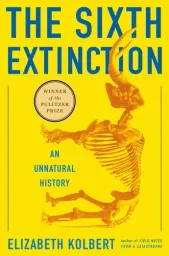
The Sixth Extinction had been on my reading list for a long time. After finishing The Thinking Machine, I was looking for the next book to read and found it in the science section of e-kirjasto (the e-library). I picked it up immediately.
The book is ostensibly about the Anthropocene - the current age, where humanity has inevitably caused extinction of a large swathe of creatures on earth, and continues to do so.
Kolbert focuses on the French naturalist Georges Cuvier, and through him explains how Extinction was discovered. Before Cuvier, most scientists believed nature was stable. From then, she moves onto Darwin and other thinkers of the time and how they came up with the theories of natural selection and evolution. While reading this sections I was thinking how the easy it is for us to take this knowledge for granted, and an appreciation for the process and time it took to get here.
All the essays (or chapters) in the book follow a pattern - Elizabeth visits a place, talks to the scientists and has her views on topics. These range from the stories about the auks which were hunted to extinction in Iceland, to a lab in Italy which is testing how increasing CO2 levels will impact life in the oceans.
From there, she moves to the forests and trees, and talks about a long running project that tries to figure out what happens when forests are broken down into patches.
I found the chapter on large animals and their extinction interesting, in that whatever strategies that had worked for so long - be so large that you are predator proof - does not work against us humans. In this chapter, we also got introduced to the idea (and fact) of humans working really hard to conserve and protect these animals now.
Another history lesson followed, by looking at the Neanderthals and how humans might have caused their extinction. And trying to find what genes caused humans to have the drive to explore and spread across the globe. Neanderthals stopped at the water, we built boats to cross it.
There was no closure or false optimism at the end of the book. Humans are the cause of this ongoing extinction and we alone have the power to do something about it. Or, we may perish along with all the others we have perished and giant rats will inherit the earth.
Paths into this note
3 notes lead here
-
I was reading The Sixth Extinction then, so I looked it up in the e-library app, and did not find it there. So, I searched for it on Audible, and bought it there.
-
I am reading The Sixth Extinction right now. This book is about the Anthropocene or the human epoch, i.e. the age of extinction we are living in right now.
-
While listening to his story in The Sixth Extinction, I came to know about his colleague - Lamarck who was a proponent of evolution. Cuvier did not believe in evolution.