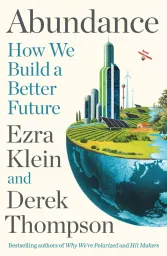
This book did not turn out to be how I had imagined it would be. Maybe by looking at the title, maybe by looking at the cover, I was hoping for it to be a description of a future world achieved by technology, a future of abundance, of steps humanity might take to get there. Perhaps, I was hoping for a non-fiction version of Kim Stanley Robinson’s -The Ministry For The Future.
Instead, this book was a study of American politics, about liberalism, about how inventions occur, about how inventions are just the beginning, about how execution is what turns inventions into successful things society can use.
This book is also about political moments, and how they are independent of which party one actually belongs to. This book advocates for a future of abundance instead of scarcity, for building things swiftly, for inventing technologies needed to further the green movement and build a future that does not destroy humanity.
It left me feeling hopeful. We need more of this in this world. We need good things and hope for a better future.
Paths into this note
5 notes lead here
-
The first book I tried was in fact badly done and so I found more reason to not do it. Then, I tried again, this time with - Abundance: How We Build a Better Future. And I found myself coming around to audiobooks.
-
They made a similar argument in Abundance: How We Build a Better Future.
-
They made a similar argument in Abundance: How We Build a Better Future.
-
Heard about this in Abundance: How We Build a Better Future.
-
I have discovered audio books recently. This is the second book I’ve read by hearing it on Audible. The first was Abundance by Ezra Klein and Derek Thompson. And in my very limited experience with audiobooks, I feel fiction is better suited to the format. With non-fiction, I tend to take notes and that is hard with audiobooks.