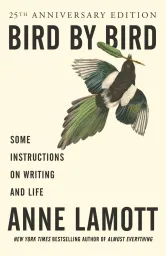
Review
I picked this book from a quote on Note to Self by Gina Trapani.
I think perfectionism is based on the obsessive belief that if you run carefully enough, hitting each stepping-stone just right, you won’t have to die.
The truth is that you will die anyway and that a lot of people who aren’t even looking at their feet are going to do a whole lot better than you, and have a lot more fun while they’re doing it.
— Anne Lamott in Bird by Bird, one of my favorite books about writing.
I read this and thought, someone’s favourite book on writing is a good bet on it being a good book on writing. And so I bought it on Kindle, and started reading.
The book has four sections which talk about the different parts of being a writer - writing, mind, help and getting published. There is a last fifth section too, but it’s one chapter, the last chapter.
I enjoyed reading this. Maybe not as much as Stephen King’s On writing. But I had read that one a long time ago and we tend to fondly remember long off things.
There were a lot of useful ideas and things to do in the novel - like writing about your childhood, writing in smaller chunks, and writing being the main thing - not the fame, getting published, etc.
Some notes follow.
Notes
From the first chapter, two lessons -
- Work in manageable smaller chunks
- Write the first shitty draft, improve it over the second, third drafts
I think perfectionism is based on the obsessive belief that if you run carefully enough, hitting each stepping-stone just right, you won’t have to die. The truth is that you will die anyway and that a lot of people who aren’t even looking at their feet are going to do a whole lot better than you, and have a lot more fun while they’re doing it.
Writing is about hypnotizing yourself into believing in yourself, getting some work done, then unhypnotizing yourself and going over the material coldly.
On the importance of making notes.
And I’d stand there trying to see it, the way you try to remember a dream, where you squint and it’s right there on the tip of your psychic tongue but you can’t get it back. The image is gone. That is one of the worst feelings I can think of, to have had a wonderful moment or insight or vision or phrase, to know you had it, and then to lose it. So now I use index cards.
You don’t want to spend your time around people who make you hold your breath. You can’t fill up when you’re holding your breath. And writing is about filling up, filling up when you are empty, letting images and ideas and smells run down like water—just as writing is also about dealing with the emptiness. The emptiness destroys enough writers without the help of some friend or spouse.
I think that most of your characters believe, as children believe, that if the truth were known, they would be seen as good people. Truth seems to want expression. Unacknowledged truth saps your energy and keeps you and your characters wired and delusional. But when you open the closet door and let what was inside out, you can get a rush of liberation and even joy.
On giving.
The other is to think of the writers who have given a book to me, and then to write a book back to them. This gift they have given us, which we pass on to those around us, was fashioned out of their lives. You wouldn’t be a writer if reading hadn’t enriched your soul more than other pursuits. So write a book back to V. S. Naipaul or Margaret Atwood or Wendell Berry or whoever it is who most made you want to write, whose work you most love to read. Make it as good as you can. It is one of the greatest feelings known to humans, the feeling of being the host, of hosting people, of being the person to whom they come for food and drink and company. This is what the writer has to offer.
Paths into this note
4 notes lead here
-
Make a list of things that speak to you. Things that you want to write about. Things hidden in your subconscious. Aligns, a little bit with the exercise from Bird by bird, about writing stories from your childhood.
-
Like Bird by bird, I started reading this book thanks to this post on Gina Trapani’s blog. That’s the beauty of books and blogs and sharing things that books teach us. It may inspire the reader to pick up the book as well.
-
I started reading Bird by bird last week. One of the exercises in the beginning of the book (and this is not a book about exercises by the way) was to think about the lunches you’ve had in school and write about those. As an exercise. Writing of course is different from the dreams one has of being a published author. Writing is a daily thing - a practice. This book is about the lessons and improving the practice.